
How to fill out Texas homestead exemption form 50-114: The Complete Guide (Updated 2026)
By Harsha N Hegde
If you bought a new home and moved in recently, don’t forget to apply for your homestead exemption on form 50-114. Apart from the general homestead exemption of $140,000, you get several other reductions on your appraised value. Homestead exemption also caps your annual appraised value increase.
Pre-requisite for filing homestead exemption in Texas
Keep a scanned copy of your Texas Driver’s License handy when you begin your homestead exemption application. Make sure your DL reflects your new home address.
File your homestead exemption forms online for FREE
Most counties have the homestead exemption form online. Applying for the homestead exemption is FREE and easy. DO NOT PAY anyone to fill up and/or file your homestead exemption. You can do it yourself from the comfort of your home! This guide will help answer some questions you may have. Reach out to your county’s appraisal district if you have a special situation not covered in the form instructions. They are the best people to guide you.
Scam Alert: Beware of the various homestead exemption scams
Claim homestead exemption retroactively for the past two years.
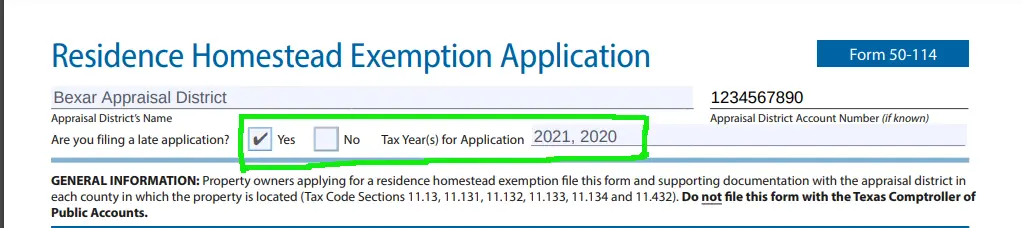
The very first question on the homestead exemption application pertains to late homestead application. In case you forgot to file for your homestead exemption when you moved in, you can claim homestead exemption retroactively for up to two years Check “Yes” and mention the previous years that you are claiming homestead exemptions for.
e.g., if you moved in to your new home in 2023 and you forgot to apply for your homestead exemption, you can apply now (in 2026) and claim retroactively for 2024 and 2025. For 2023, you likely go the benefit of homestead exemption from the previous owner. If case it was a new build or the previous owner didn’t have a homestead exemption, then your opportunity to claim a prorated exemption for 2023 is no longer available.
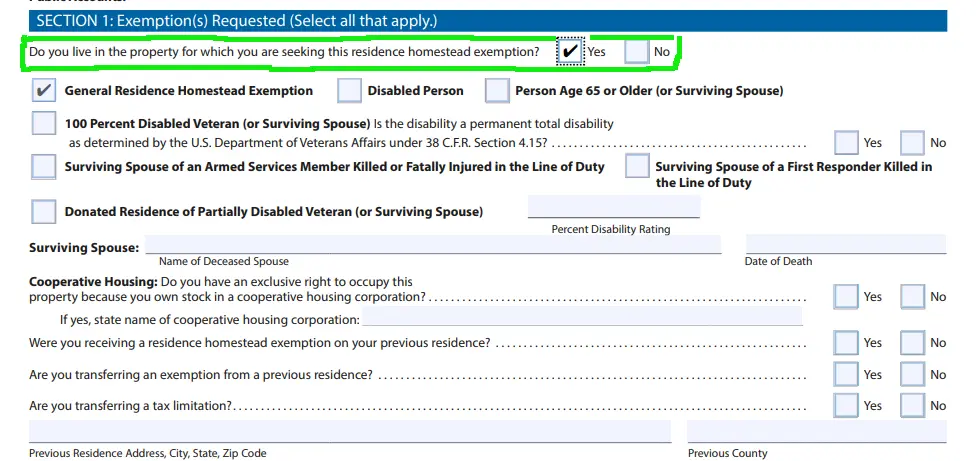
Section 1 - Exemptions Requested
An important question in Section 1 of the form is to confirm that you are claiming homestead exemption for your primary residence. Remember that as per Texas Tax Code, homestead exemption is available only for your primary residence. If you claim “No” on this question, then you are not eligible to claim homestead exemption on this property.
Where to find Property ID for homestead exemption?
You can find your Property ID/Account Number using your county appraisal district’s “Property Search” feature. Most appraisal district websites let you search by address or owner name. Search results are generally shown along with your property ID. If you have your latest “Notice of Appraised Value”, you can find your property id/account number on it.
In case you are unable to find your property ID, it is okay to not enter it. Just provide the correct property address and the appraisal district will take care of locating the Property ID/account number. This is an optional field.
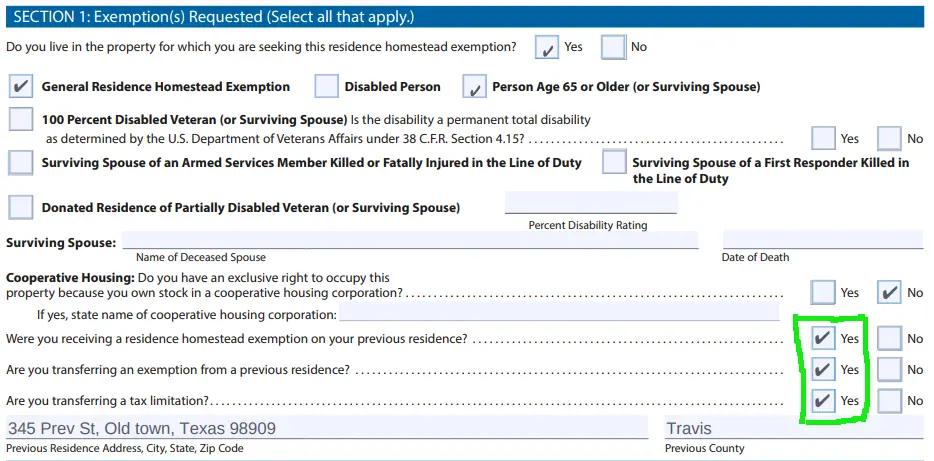
Are you transferring an exemption from a previous residence?
Texas law does not allow property owners to transfer their general residence homestead exemption. They have to apply afresh for their general residence homestead exemption on their new home the following year.
Over 65, disabled exemptions and tax ceiling can be transferred though. If you are transferring your over-65 or disabled exemption, you can check the three boxes related to it:
Section 2 - Information on property owner(s)
Provide the name, date of birth, TDL number (or SSN) of the owners along with percent ownership. If you are an unmarried couple, select “Other” and list out your ownership percentages. If you are a married couple, then each of you will own 100%. That is because Texas is a community property state.
Section 3 - Property information
Provide the address of the property for which you are claiming homestead exemption, the date of purchase (this will generally be the date on the deed) and date you moved in to your new home. You can find the legal description of your property on your appraisal district website. Providing it is optional. You can still submit your application without legal description.
Is the applicant identified on deed or other recorded instrument?
If you are the sole owner or partial owner of the property, your name will be listed on the sale deed. Click “Yes” and provide the deed number. You can find the deed number on your deed papers. You can also look them up on your county clerk’s website. If your ownership is not on record, then you need to provide a notarized affidavit on Form 50-114-A affirming your ownership interest in the property. We have covered this section in detail here.
What is the “Court record/filing number on recorded deed or other recorded instrument”?
It’s the county clerk’s recording identifier for the document that proves you own the property—usually called the Instrument No. or Document No. (older deeds may show Book/Page). It’s assigned by the county clerk when your deed (or similar ownership document) is recorded in the county’s real property records.
Where to find it
- On your recorded deed PDF from closing: look for a stamped header that says Instrument No., Clerk’s File No., Doc No., or similar.
- If you don’t have the PDF, search your County Clerk – Real Property records online and open the deed image (examples: Harris County Clerk’s deed search, Dallas County, Travis County).
- Formats vary by county (e.g., a numeric instrument number or a volume/page on older records). Any of those is acceptable.
What to enter on Form 50-114
- Enter the Instrument/Document Number (or Book and Page, if that’s how your deed is referenced).
- If you truly can’t locate it, don’t stall your filing—submit the application; the appraisal district can verify.
- If your name is not shown on a recorded deed/record (common with heir property), check No and attach the Comptroller’s Form 50-114-A (Affidavits) as instructed.
Do NOT enter
- Your CAD account number (that’s appraisal data, not land records).
- The title company’s File/Escrow number.
- A court cause number (unless the court order itself was recorded in the real property records—if so, use the recorded instrument number for that order).
Tip: When you find your deed in the county’s system, copy the instrument/recording number exactly as shown (include any dashes or year prefixes if present).
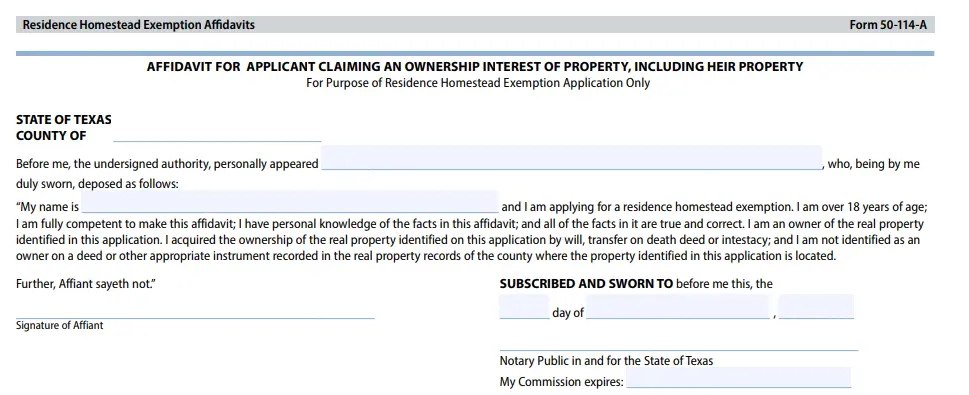
This is applicable if this is an heir-property. If any portion of your property is let-out/income producing, that needs to be mentioned in this section.
Section 4-5: Waiver of documentation and additional information
If you are a U.S. Armed Services member on active duty, you can request for waiver of the required documentation. If you need to provide any additional information, you may do so in section 5.
Section 6: Affirmation and Signature
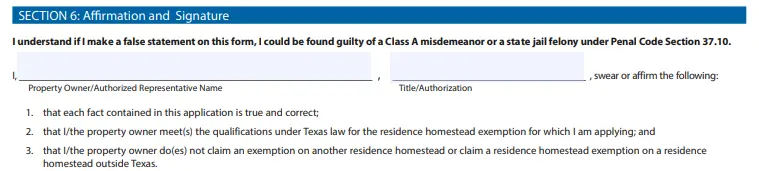
This section is for submitting the form and undertaking. There are two blanks here. In the first blank “Signature of Property Owner/Applicant or Authorized Representative”, you have to affix your signature. For the second blank, “Title/Authorization”, if you are the owner, then write “Owner” in the blank. If the property has multiple owners (e.g, heir property with multiple heirs), and you are the authorized representative, authorized to apply for the exemption, you can just say: “Aurthorized Heir” or “Authorized Representative”.
You may then sign and submit your Texas Homestead Exemption application.
Typically, most appraisal districts process homestead exemption applications in 4 to 6 weeks. But during the protest hearings season (March through July), your appraisal district may take more time to process the application. If you applied during the protest season, your homestead applications take several months to be processed. Hence, our recommendation is that you apply for your homestead exemption as soon as you move in and have your Texas DL address updated.
Beginning 2022, new homeowners can apply for homestead exemption anytime of the year. If the chief appraiser requires more information, you will be contacted via your email or phone. Keep an eye on your email inbox.
Form 50-114 example
Example of form 50-114 filled up considering a first time homeowner
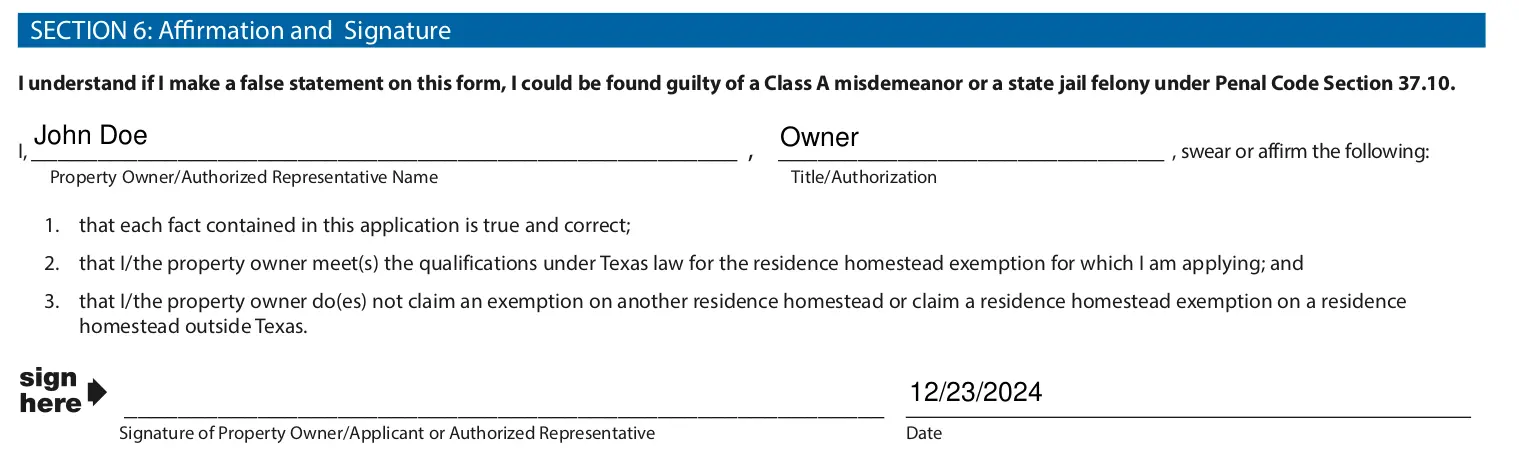
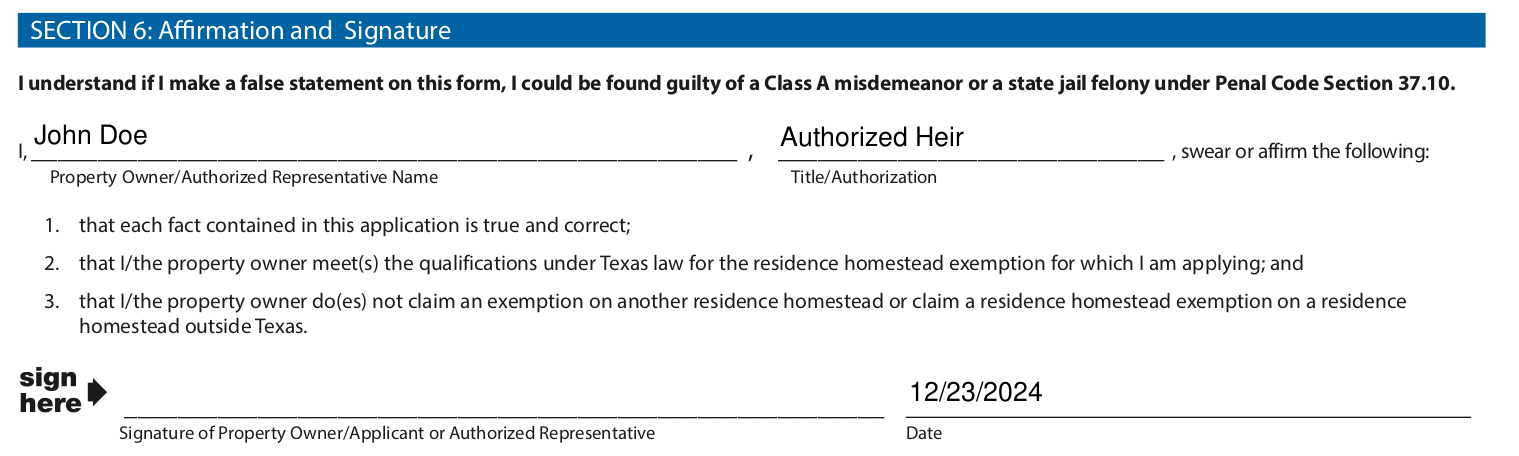
Title/Authorization example
If you are the owner, then write “Owner” in the field. If the property has multiple owners (e.g, heir property with multiple heirs), and you are the authorized representative, authorized to apply for the exemption, you can just say: “Authorized Heir” or “Authorized Representative”.
About the Author
Harsha N Hegde is the founder of squaredeal.tax, a DIY platform that helps Texas homeowners protest unfair property tax assessments. He has helped thousands of Texas homeowners save money using comps-based evidence and practical guidance.
Related Posts
Have questions? Use the comments section below to ask. We respond to all questions!