
Texas Heir Property Homestead Exemption – The Complete Guide
By Harsha N Hegde
In Texas, heirs living in inherited homes can claim a full homestead exemption under Texas Tax Code § 11.13(h).
Senate Bill 1943 (2019) simplified the process — no recorded deed required. Submit Form 50-114, Form 50-114-A, a death certificate, and a utility bill to your county appraisal district.
What Is an Heir Property Homestead Exemption?
An heir property is property inherited when the deed hasn’t yet been updated with the heirs’ names. Texas law allows heirs who occupy the home as their principal residence to qualify for 100% of the homestead exemption, even if there are multiple co-owners.
Who Qualifies for Heir Property Homestead Exemption?
You can claim a homestead exemption on heir property if:
- You inherited the property via will, intestacy, or transfer-on-death deed.
- You live in the property as your primary residence.
- You can prove ownership, even if your name isn’t on the deed yet.
💡 Tip: Texas law ensures heirs are no longer limited to a proportional exemption based on their ownership share.
How to Claim the Heir Property Homestead Exemption (Step-by-Step)
Step 1. Get the Right Forms
Download and complete:
Step 2. Complete Section 3 of Form 50-114
- Mark that your property is heir property. Check “Yes” for “Is the property for which this application is submitted an heir property?”
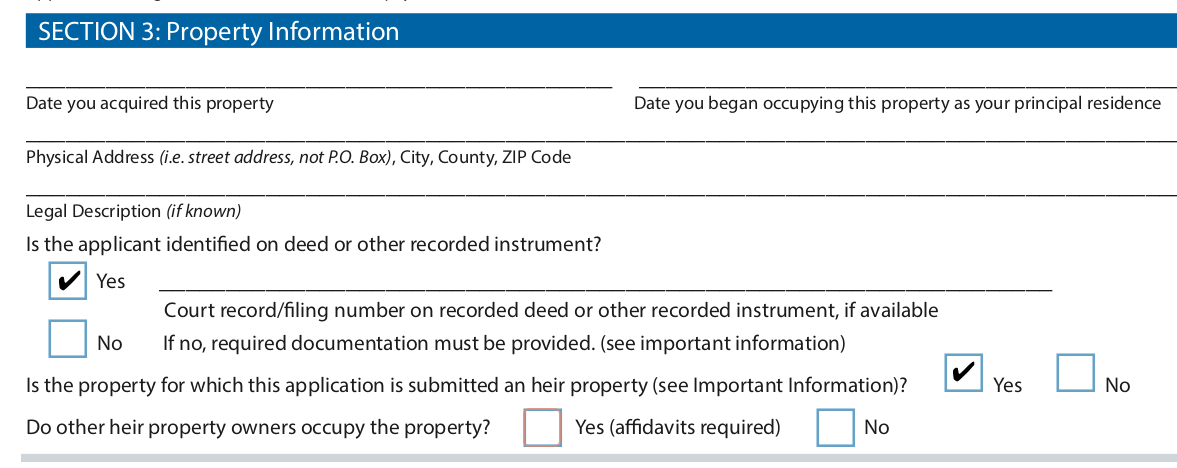
- Sign your affidavit of heirship before a notary and get it notarized.

- If probate is filed, write the court record/filing number for “Court record/filing number on recorded deed or other recorded instrument.”
- If multiple heirs occupy the property as their primary residence, attach their notarized affidavits authorizing you to apply for homestead exemption. If you are the only heir to live there, the no need for their authorization affidavits.

Step 3. Attach Required Documents
Include:
- A copy of the prior owner’s death certificate.
- A recent utility bill showing your name or residence.
- Court citations (probated will, divorce decree) if available.
- A notarized affidavit establishing your ownership interest (Form 50-114-A).
Step 4. Submit to Your County Appraisal District
- File your application online or by mail.
- Filing is free — don’t pay anyone to do this for you.
Texas Law on Heir Property Homestead Exemption
Under Texas Senate Bill 1943 (2019), several sections of the Texas Tax Code were updated to protect heirs claiming a homestead exemption:
-
Texas Tax Code § 11.13(h):
An heir property owner who occupies the property as a principal residence is considered the sole recipient of the full homestead exemption — even when multiple co-owners exist.
Read § 11.13(h) → -
Texas Tax Code § 11.43(o):
Simplifies the application process — heirs can provide:- A notarized affidavit of heirship
- The prior owner’s death certificate
- A recent utility bill
- Affidavits from any co-residing heirs
No recorded deed is required.
Read SB1943 →
-
Definition of “Heir Property” (§ 1.04(20–21)):
Property inherited via will, intestacy, or transfer-on-death deed — even if the title hasn’t been updated.
View definition → -
Title Protection (§ 11.49):
Approving or denying the exemption does not affect legal title and appraisal districts cannot be drawn into ownership disputes.
How the Law Changed
| Before SB 1943 (Pre-2019) | After SB 1943 (Current Law) |
|---|---|
| Exemption pro-rated based on ownership share | Heir occupant gets 100% exemption, regardless of co-owners |
| Recorded deed often required | Affidavit + death certificate accepted instead |
| Co-owner disputes complicated applications | Single heir can apply if occupying as primary residence |
Why this matters: Thanks to SB 1943, heirs living in inherited homes can claim the full homestead exemption even if the title isn’t updated or there are multiple co-owners.
What Is an Affidavit of Heirship in Texas?
An Affidavit of Heirship is a sworn legal document used in Texas to identify the rightful heirs of a deceased property owner when the title hasn’t been updated.
It is especially important for claiming the homestead exemption on heir property because it proves your ownership interest without requiring a full probate process.
When You Need It
You’ll typically file an affidavit of heirship when:
- The deceased died without a will (intestate).
- The property title is still in the deceased’s name.
- You want to apply for a homestead exemption but don’t have a recorded deed showing you as an owner.
- You don’t want to go through probate because it’s costly or unnecessary.
What the Affidavit Includes
A valid Affidavit of Heirship typically contains:
- The name of the deceased and date of death.
- A description of the property (legal description and address).
- A list of heirs and their relationships to the deceased.
- Statements from two disinterested witnesses (people who knew the deceased but are not heirs).
- Signatures and notarization for validation.
Why It Matters for Homestead Exemptions
Under Texas Tax Code § 11.43(o), heirs can claim the full homestead exemption even if the deed isn’t updated — provided they:
- Occupy the property as their principal residence.
- Attach a notarized Affidavit of Heirship to their homestead exemption application.
This affidavit essentially proves your ownership rights without requiring probate.
How to File It
- Download the Form
Use the official Form 50-114-A – Affidavit for Heir Property Owners. - Complete the Details
Include information about the deceased, the heirs, and the property. - Sign Before a Notary
You and the witnesses must sign in front of a notary public. - Submit With Your Application
Attach it to your Form 50-114 Homestead Exemption Application and submit it to your county appraisal district.
Key Takeaways
- Filing is free — you don’t need an attorney or probate court.
- Required by most appraisal districts for heir property exemptions.
- Helps establish your ownership for property tax purposes.
- While it doesn’t transfer legal title automatically, it strengthens your claim and simplifies future title updates.
Homestead Exemption with Multiple Heirs
1. Only the Occupying Heir Can Claim the Exemption
- The heir who lives in the property as their principal residence can claim the full homestead exemption.
- The exemption is not split based on ownership shares.
- Example:
- Three siblings inherit a house.
- One sibling lives there full-time.
- That sibling gets the 100% homestead exemption benefit, even if they own only ⅓ of the property.
Legal Basis:
Texas Tax Code § 11.13(h) —
“An heir property owner who qualifies heir property as the owner’s residence homestead … is considered the sole recipient of any exemption granted under this section.”
2. Non-Occupying Heirs Don’t Lose Their Ownership Rights
- The exemption affects property taxes only, not ownership.
- Even if one heir claims the exemption, all heirs still own their share of the property.
- If the property is sold later, proceeds are divided according to ownership percentages — not exemption usage.
3. Consent from Co-Residing Heirs
- If other heirs also live in the property, each must sign a notarized affidavit authorizing the applicant to claim the exemption.
- If other heirs don’t live there, their consent is not needed.
Required Form:
Form 50-114-A — Affidavit for Owner Other Than Applicant Occupying Heir Property
4. If No Heir Lives There
- If none of the heirs occupy the property as their primary residence, the homestead exemption cannot be claimed.
- The property will be taxed at the full market value until one heir makes it their residence.
5. Impact on Tax Caps
Once the exemption is granted:
- The property benefits from the 10% appraisal cap under Texas law.
- That protection remains in place as long as the qualifying heir continues to occupy the home as their principal residence.
Quick Example
| Scenario | Homestead Exemption | Tax Benefit | Ownership Rights |
|---|---|---|---|
| 3 heirs, 1 occupies | ✅ Yes, 100% exemption | Lower taxable value + 10% appraisal cap | Ownership still split equally |
| 3 heirs, none occupy | ❌ No exemption | Full property taxes apply | Ownership unchanged |
| 2 heirs occupy, 1 doesn’t | ✅ Yes, exemption applies if at least one occupies | Same 10% cap applies | Ownership unaffected |
Key Takeaways
- Only an occupying heir can claim the full homestead exemption.
- Non-occupying heirs still keep their ownership rights.
- Consent affidavits are only needed if multiple heirs also live in the home.
- If no heir treats the property as their residence → no homestead exemption.
Who Pays Property Taxes on Inherited Homes in Texas?
In Texas, property taxes don’t go away when a property owner dies. Someone must ensure taxes are paid to avoid penalties, liens, or even foreclosure.
1. During Probate
- If the deceased owner’s estate is in probate, the executor (named in the will) or administrator (appointed by the court) must ensure property taxes are paid.
- Payments are made from estate funds, if available.
- Unpaid taxes during probate still accrue penalties and interest, and the county can file a tax lien against the property.
Legal Reference: Texas Tax Code § 32.01 – Tax Lien
2. After Probate or When No Probate Is Filed
- Once the property passes to heirs, all heirs are jointly responsible for property taxes.
- Texas treats heirs as co-owners based on their ownership shares, but the county sends one combined bill.
- Practically, heirs must decide among themselves who will pay.
If no agreement is reached and taxes remain unpaid, all heirs are at risk.
3. If One Heir Lives in the Property
- If one heir uses the property as their primary residence, they can:
- Claim the homestead exemption.
- Benefit from a lower taxable value and a 10% annual appraisal cap.
- In most families, the occupying heir pays the property taxes, but legally all heirs remain jointly liable.
Tip: Apply for the Texas Homestead Exemption (Form 50-114) to reduce your property tax burden.
4. If No Heir Occupies the Property
- When no heir treats the property as their primary residence:
- No homestead exemption applies.
- Property taxes are calculated at full market value.
- Heirs must coordinate payment or risk penalties and foreclosure.
5. If Taxes Aren’t Paid
- Property taxes in Texas are secured by a lien under Texas Tax Code § 32.01.
- Unpaid taxes lead to:
- Monthly penalties and interest.
- A tax lien recorded against the property.
- Possible tax foreclosure by the county.
- Foreclosure affects all heirs, even if some weren’t living in the property.
Quick Summary Table
| Situation | Who Pays Taxes | Homestead Exemption | Risk if Unpaid |
|---|---|---|---|
| Estate in probate | Executor/administrator | ✅ If an heir occupies | Lien + penalties accrue |
| After probate, multiple heirs | All heirs are jointly liable | ✅ Yes, if one heir occupies | Lien + possible foreclosure |
| One heir occupies | Usually that heir pays | ✅ Full benefit applies | Other heirs still liable |
| No heirs occupy | Heirs must coordinate | ❌ No exemption | Full taxes + foreclosure |
Key Takeaways
- All heirs are jointly responsible for property taxes unless the estate is in probate.
- If one heir lives in the property, they usually:
- Claim the homestead exemption.
- Benefit from lower taxes.
- Often take responsibility for paying taxes — but the county still considers all heirs liable.
- Unpaid property taxes can lead to liens, penalties, and foreclosure, regardless of inheritance.
📝 Pro Tip: If you’ve inherited a home and one heir plans to live there, file the homestead exemption immediately to reduce taxes and secure the 10% appraisal increase cap.
Download Form 50-114 →
Frequently Asked Questions (FAQs on Heir Property Homestead Exemption in Texas)
Can a heir claim a homestead exemption in Texas?
Yes. Under Texas Tax Code § 11.13(h), an heir who occupies the inherited property as a primary residence can claim the full homestead exemption, regardless of co-ownership.
- Non-occupying heirs still keep their ownership rights, but they don’t receive the tax benefit.
- If other heirs also live in the home, they must sign a notarized affidavit authorizing the applicant to claim the exemption.
- If none of the heirs live in the home, no homestead exemption applies.
What documents are required for heir property homestead exemption in Texas?
You’ll need:
- Form 50-114 – Homestead Application
- Form 50-114-A – Affidavit for Heir Property Owners
- Prior owner’s death certificate
- Recent utility bill
- Co-residing heirs’ affidavits (if applicable)
Do heirs need a recorded deed to qualify?
No. Senate Bill 1943 (2019) removed this requirement. An affidavit of heirship, along with supporting documents, is sufficient to establish eligibility.
Does the homestead exemption cap property tax increases?
Yes. Once approved, the homestead exemption caps annual appraisal increases at 10%, protecting heirs from sudden tax spikes.
What happens if property taxes are unpaid during probate?
Taxes continue to accrue during probate. If unpaid, heirs risk penalties, liens, or foreclosure. To keep the property, make payments promptly or contact your county appraisal district for payment plans.
I inherited a property that had homestead exemption. Do I need to apply for it again?
Yes, whenever there is a change to the ownership records, including inheritance, the new owner has to reapply for homestead exemption. Applying is free. Most appraisal districts have the homestead exemption application online. It is an easy DIY. Don’t pay anyone for applying your homestead exemption.
My brother and I inherited our father’s house. The house is my primary residence. County records show ownership is 50% for each of us. But CAD says I am eligible for only 50% homestead exemption. How to fix this?
If the property is heir property and you live in the home as your primary residence, you may qualify for the full homestead exemption, not just your ownership percentage.
Under Texas Tax Code Section 11.13(h), an heir property owner who qualifies for residence homestead is considered the sole recipient of the homestead exemption, even if they only own a partial interest in the property. Step 1 – File the Heir Property Affidavit
You should submit Form 50-114-A along with your homestead application (Form 50-114).
On Form 50-114-A, complete the section:
“Affidavit for Applicant Claiming an Ownership Interest of Property, Including Heir Property.”This establishes that:
* You inherited the property
* You have an ownership interest
* You live in the property as your principal residence
* You are not on the deed yet (common for inherited property)
If your driver license and voter registration show this address as your primary residence, you generally qualify.
Step 2 – Contact the Appraisal District
After submitting the affidavit, contact your appraisal district and explain that this is heir property homestead under Tax Code 11.13(h). Often, once a CAD appraiser reviews the affidavit, they will correct the exemption.
Step 3 – If CAD still limits you to 50%, file a protest
If the appraisal district refuses to grant the full homestead exemption, file a protest using Form 50-132 (Notice of Protest). In Section 3 – Reasons for Protest, check:
“Exemption was denied, modified or canceled.”Explain that you qualify for 100% homestead exemption as an heir property owner under Texas Tax Code 11.13(h) and attach:
* Form 50-114
* Form 50-114-A
* Death certificate of prior owner
* Driver license showing the property address
* Utility bill (optional but helpful)
Many homeowners win this issue at the protest stage because the law is very clear.
What happens to the homestead exemption after the owner dies?
The exemptions pass on to the surviving spouse or heir(s).
About the Author
Harsha N Hegde is the founder of SquareDeal.tax, a DIY platform that helps Texas homeowners protest unfair property tax assessments.
He has helped thousands of Texans save money using comps-based evidence and practical guides like this one.
Related Posts
Have questions? Use the comments section below to ask. We respond to all questions!