Should You Disclose Your Home Sale Price in Texas?
Quick Answer: You’re not legally required to disclose your home’s sale price in Texas. But in many cases, voluntarily sharing it can benefit you — by improving comps, strengthening your property tax protest, and promoting a fairer appraisal system AND saving you the hassle of protesting the first year.
TL;DR
- No mandatory disclosure: Texas law doesn’t require homeowners to tell CADs the sale price.
- Confidential if obtained: Sales data from private sources is confidential (Gov’t Code §552.149). If you voluntarily share your price under a promise of confidentiality, it stays confidential.
- Net effect: CADs still get most sales via vendors or MLS access; you just don’t see them. Disclosing can reduce guesswork and help first-year accuracy.
The Details
If you are a new homeowner in Texas, you may have received a survey from your county appraisal district asking you to voluntarily disclose your sale price. Appraisal districts also regularly announce on social media asking homeowners to disclose their sale price. e.g. here is an announcement from Fort Bend CAD,
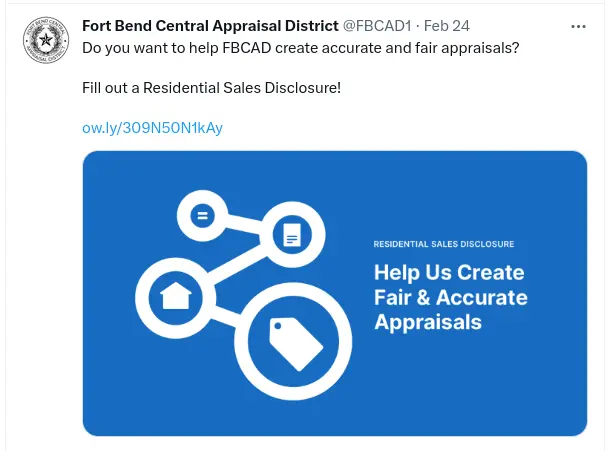
While most property tax professionals and realtors advise you to “throw the survey in the trash can”, our advice is contrary.
What “Non-Disclosure State” Actually Means
Texas is considered non-disclosure because no statute compels you to report the residential sale price to CAD. Portals like Zillow don’t publish Texas sold prices as public record; MLS holds the data. If your property is listed on MLS, then MLS has your sale price.
However, disclosing your sale price can still work in your favor:
- Prevents inflated appraisals in your first year
- Strengthens property tax protests
- Reduces taxpayer costs
- Builds a better comps database for everyone
Texas law: non-disclosure and confidentiality
These two provisions explain why sale prices are not public and why districts will not release broad sales dumps:
- Government Code §552.149: Real-property sales information received from a private entity by the comptroller or a chief appraiser is exempted from public disclosure.
- Tax Code §22.27(a): Information the owner provides to an appraisal office in connection with appraisal, including sales prices voluntarily disclosed after a promise of confidentiality, is confidential and not open to public inspection.
Common Myths About Sale Price Disclosure
| Myth | Reality |
|---|---|
| “Disclosing my sale price will raise my property taxes.” | ❌ CADs already get your sale price through MLS or vendors. |
| “Sale prices are private.” | ❌ Realtors, brokers, and CADs with MLS access already see them. |
| “Zillow hides prices to protect you.” | ❌ Zillow legally cannot display Texas sale prices. |
| “If I don’t disclose, CAD won’t find out.” | ❌ CADs buy the data anyway. You just pay for it indirectly. |
Why Sales Price Disclosure Can Help You
- Avoid Inflated Appraisals: Without accurate sale price data, CADs more often than not, estimate a higher value (a.k.a. “Sales Chasing”), forcing you to disclose your sale price at the protest hearing. Voluntary disclosure avoids you the hassle of a protest the first year.
- Strengthen Property Tax Protests: When protesting, CADs use MLS comps you don’t easily get. Sales price public disclosure helps everyone access better comps.
- Reduce Taxpayer Costs: CADs spend your tax dollars buying MLS data. Voluntary disclosure saves money for everyone.
- Promote Transparency: More disclosed data = fairer appraisals across neighborhoods.
- Empower You: There can be more DIY services like squaredeal.tax that can help you put together a sales comps grid to counter CAD’s value estimate and help you win your protest.
How Appraisal Districts Already Get Sale Prices
Even without disclosure, CADs buy:
- MLS data through broker agreements
- Third-party reports from vendors like CoreLogic, Black Knight, or ATTOM
So, they already know your sale price — you just don’t benefit from that info.
Privacy vs Power: Who Actually Benefits from Non-disclosure?
Non-disclosure mainly preserves data gatekeeping.
- MLS rules require agents to load closed sales quickly, including the selling price. For example, HAR’s MLS rules require loading sales-closed information within three days of closing, including the selling price
- Trade groups lobby against public sales-price disclosure. Texas REALTORS’ legislative priorities state opposition to any mandate to publicly disclose real-estate sales prices.
Homeowners lose visibility while CADs and vendors retain it. Most states do publish sale prices; Texas is in the minority that does not. The popular reason for non-disclosure that it invades privacy, doesn’t hold water. The bigger privacy risks affecting consumers today come from online fraud and large data breaches, not county deed books.
Why Zillow Doesn’t Show Sold Prices
Because Texas is a non-disclosure state, portals like Zillow, Redfin, and Realtor.com cannot legally display home sale prices publicly.
For you, the only way to see sales data is ask a Realtor with MLS access. Most give you sales comps for free, in exchange for your contact info. Some may
charge a fee.
2026 Update: Legislative Trends
- Texas still does not mandate disclosure.
- CADs are signing MLS access agreements, giving them even broader visibility.
- Policy groups like Every Texan are pushing for mandatory reporting to create fairer valuations.
Where to Get Recent Home Sale Prices
Ask a Realtor: Most will share MLS comps for free, in exchange for your contact info. Some may charge a fee.
The Bigger Picture: Why Sale Price Disclosure Matters
As noted in this Every Texan article, Sales price disclosure is a much needed reform:
Texas appraisal districts lack the most complete and accurate basis for determining property values. This is like making a store clerk guess the correct sales tax on an item while you cover up the bar code and hide the price.
The result is that difficult-to-assess commercial properties and high-end homes tend to be undervalued. Owners of these properties therefore pay less than what they should in taxes that support public services, which then shifts the financial burden onto lower-income homeowners. Requiring reporting of all real estate transactions will be essential in correcting this imbalance and recognizing the changed values of property.
By voluntarily disclosing your sale price, you contribute to a fairer property tax system—helping yourself and your fellow homeowners. The next time your appraisal district asks for your sale price, consider sharing it to promote transparency and accuracy in property assessments.
FAQs
Are home sales prices public in Texas?
No, property sale prices are not public in Texas. Texas is a non-disclosure state. But, sale prices are available on MLS. You can ask a realtor for sale prices in your neighborhood. Most give it for free in exchange for your contact information. But some may charge a fee.
Final Thoughts
Texas protects homeowner privacy by not requiring disclosure. But appraisal districts already know your sale price — they just don’t share it back.
Voluntarily disclosing your sale price helps you and other homeowners by improving comps access, reducing inflated valuations, and saving taxpayer dollars.
About the Author
Harsha N Hegde Founder of squaredeal.tax, a DIY platform helping Texas homeowners protest unfair property tax assessments using comps-based evidence and practical guidance.
Related Posts
Have questions? Use the comments section below to ask. We respond to all questions!