
Can Married Couples Claim Two Homestead Exemptions in Texas?
Homestead exemptions are one of the biggest tax breaks available to Texas homeowners, including married couples. But the rules get complicated when you and your spouse own separate homes or live apart. Let’s dive in to the intricacies.
1. The General Rule — One Homestead Per Married Couple
Under the Texas Tax Code §11.13(h), a married couple can only claim one homestead exemption in a given tax year, regardless of how many homes they own:
“A person may not receive a residence homestead exemption … for more than one residence homestead in the same year.
If the person is married, neither spouse may claim an exemption on a different residence.”
Key Implications
- Even if you own two homes, you and your spouse must pick one to claim the exemption.
- It doesn’t matter if you file taxes separately or maintain different mailing addresses.
- The appraisal district (CAD) enforces this strictly.
2. If One Spouse Already Has a Homestead Exemption
If one spouse owned a home before marriage and already has a homestead exemption on it:
- That exemption remains valid as long as the home is your principal residence.
- The other spouse cannot claim another exemption on a different property.
- If the other spouse also owns a home with a homestead exemption, one must be removed to comply with the law.
3. How to Report Percent Ownership on Form 50-114
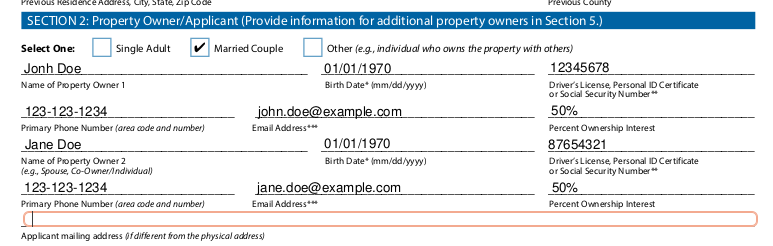
When completing Section 2 of the Texas Homestead Exemption Form (50-114), you’ll see a field asking for your “Percent Ownership Interest”.
For married couples, what you enter depends entirely on the deed language and how the property was acquired:
1. If the Home Was Bought During Marriage
- Texas is a community property state.
- By default, if the property was purchased after you were married, each spouse is presumed to own an undivided 50% interest — even if only one name is on the deed.
- What to enter:
“50%” for each spouse (unless the deed specifies otherwise).
2. If the Home Was Bought Before Marriage
- If one spouse owned the home before marriage and:
- Did not add the other spouse to the deed → that spouse owns 100%.
- Added the other spouse as a co-owner → ownership depends on the vesting language in the deed:
- “John and Jane, husband and wife” → typically 50/50.
- “John conveys 25% to Jane” → 75/25 split.
- “John adds Jane for survivorship only” → John still owns 100%.
3. If the Deed Uses Special Vesting Language
- Joint Tenancy with Right of Survivorship → usually 50/50, unless stated otherwise.
- Tenants in Common → ownership follows the specific percentages on the deed.
4. For Homestead Exemption Purposes
- Regardless of ownership percentages, the homestead exemption applies to the entire property as long as it’s your primary residence.
- The CAD doesn’t split the exemption into “your half” and “spouse’s half” — both spouses benefit fully.
Quick Tip
Always check your deed or title before filling out percent ownership.
If in doubt, request a copy from your county clerk or appraisal district.
Entering incorrect ownership percentages could delay your exemption approval.
4. The Texas Supreme Court Ruling (Johnson v. Bexar Appraisal District, 2024)
In Johnson v. Bexar Appraisal District, the Texas Supreme Court addressed whether married but separated spouses could each claim a homestead exemption on different properties.
Case Facts
- Yvondia Johnson and her husband, both 100% disabled veterans, owned two homes.
- They lived separately—she in Converse, he in San Antonio.
- Each claimed a disabled veteran homestead exemption on their own home.
What the Court Decided
- The Court ruled in favor of Johnson, holding that Texas Tax Code §11.131(b) grants the 100% disabled veteran exemption to each qualifying individual, regardless of marital status.
Key takeaway:
If both spouses are 100% disabled veterans living in separate primary residences, each may claim the disabled veteran homestead exemption.
5. Important Limitations
This ruling does NOT change the general rule for everyone else.
| Scenario | Two Homestead Exemptions Allowed? | Notes |
|---|---|---|
| Married couple, living together in one home | ❌ No | One exemption only |
| Married couple, living apart, general exemption | ❌ No | Law still limits to one |
| Married couple, living apart, both 100% disabled veterans | ✅ Yes | Allowed, but only under §11.131(b) |
| Divorced, each owns and lives in separate homes | ✅ Yes | Divorce removes the restriction |
6. Risks of Claiming Two Exemptions Illegally
Trying to double-dip without qualifying under the narrow exception can lead to:
- Back taxes for up to 5 years
- Penalties and interest
- Possible accusations of fraud
Appraisal districts are actively auditing these claims.
7. People Also Ask: Quick Answers
Can a married couple in Texas claim two homestead exemptions?
No. Texas Tax Code §11.13 limits a married couple to one residence homestead exemption per tax year.
What if each spouse lives in a different home?
Usually no. A narrow exception exists only if both spouses are 100% disabled veterans and each has a separate primary residence (Tex. Tax Code §11.131(b)).
My spouse owned a home and had a homestead exemption before we married. Does it continue?
Yes. It continues as long as that home is the couple’s principal residence. The other spouse can’t claim another exemption elsewhere.
Do both spouses need to be on the deed?
No. The exemption follows the family’s principal residence, not whether both names are on title.
How do we determine our percent ownership for the exemption form?
Check your deed and title language:
- Bought during marriage → presumed 50/50.
- Bought before marriage → depends on whether both spouses are on the deed and what the deed specifies.
- Regardless of shares, the exemption covers the entire property.
We’re separated, not divorced. Can we each claim our own homestead?
Generally no. Unless you qualify under the 100% disabled veteran exception, CADs will treat you as one unit for homestead purposes.
What happens after divorce?
The spouse who keeps and occupies the former marital home can keep/file the exemption there. The other spouse can file a new exemption on their new principal residence.
What documentation do CADs look for?
Expect a Texas DL/ID with the property address plus voter registration or utility bills. If spouses live apart, expect extra scrutiny and more proof of separate primary residences.
What are the penalties for double-claiming?
Removal of the extra exemption, back taxes, penalties, and interest (often up to 5 years).
About the Author
Harsha N Hegde is the founder of squaredeal.tax, a DIY platform that helps Texas homeowners protest unfair property tax assessments. He has helped thousands of Texas homeowners save money using comps-based evidence and practical guidance.
Have questions? Use the comments section below to ask. We respond to all questions!