
Houston High-Rise Condo Property Tax Protests (2020-2025)
Property tax protests have become a routine part of homeownership for many Houston high-rise condo owners. To understand how owners of high-rise condominiums and penthouses fare during the protest process, we analyzed every Harris County property tax protest filed for high-rise condominiums between 2020 and 2025. The dataset includes 25,729 property tax protests filed across approximately 10,000 high-rise condo units and provides one of the most comprehensive looks at how this segment of the Houston housing market responds to annual property tax assessments.
The results reveal several interesting trends.
- More than 40% of high-rise condo owners protest their assessments every year, compared with ~32% Single Family Homeowner protests
- Since 2024, professional property tax agents have rapidly become the preferred choice for representation.
- Homeowners who successfully protest on their own generally obtain reductions comparable to those achieved by professional representatives.
- Successful protests continue to reduce appraised values by tens of thousands of dollars.
The analysis also highlights something unique about high-rise condominiums. Unlike detached homes, two units in the same building can have dramatically different values because of floor level, views, renovations, and HCAD’s Condition (C) and Desirability (D) adjustments. As we’ll see later in this article, those property-specific factors can sometimes become the deciding factor in a successful property tax protest.
Key Findings
- Nearly 4 out of every 10 Houston high-rise condo owners protest their property taxes every year.
- Protest participation has remained remarkably consistent from 2020 through 2025.
- Median reductions typically range between $20,000 and $27,000.
- Since 2024, professional property tax agents have become the dominant choice for high-rise condo owners.
- Homeowners who successfully protest on their own (DIY Protests) generally receive reductions comparable to those obtained by professional property tax agents.
- Penthouse owners should pay particular attention to HCAD’s Condition (C) and Desirability (D) factors.
High-Rise Condo Owners Protest at Very High Rates
| Year | High-Rise Condos | Property Tax Protests | Protest Rate |
|---|---|---|---|
| 2020 | 10,216 | 4,158 | 40.7% |
| 2021 | 10,239 | 4,128 | 40.3% |
| 2022 | 10,239 | 4,198 | 41.0% |
| 2023 | 10,248 | 4,166 | 40.7% |
| 2024 | 10,597 | 4,397 | 41.5% |
| 2025 | 10,713 | 4,682 | 43.7% |
Unlike many other residential property types, the protest rate for Houston high-rise condominiums has remained remarkably stable. Every year, approximately 40% to 44% of all high rise condo owners protest their assessments. That suggests experienced condo owners increasingly view protesting as a routine part of property ownership rather than an exceptional event.
Protest Success Has Become More Challenging
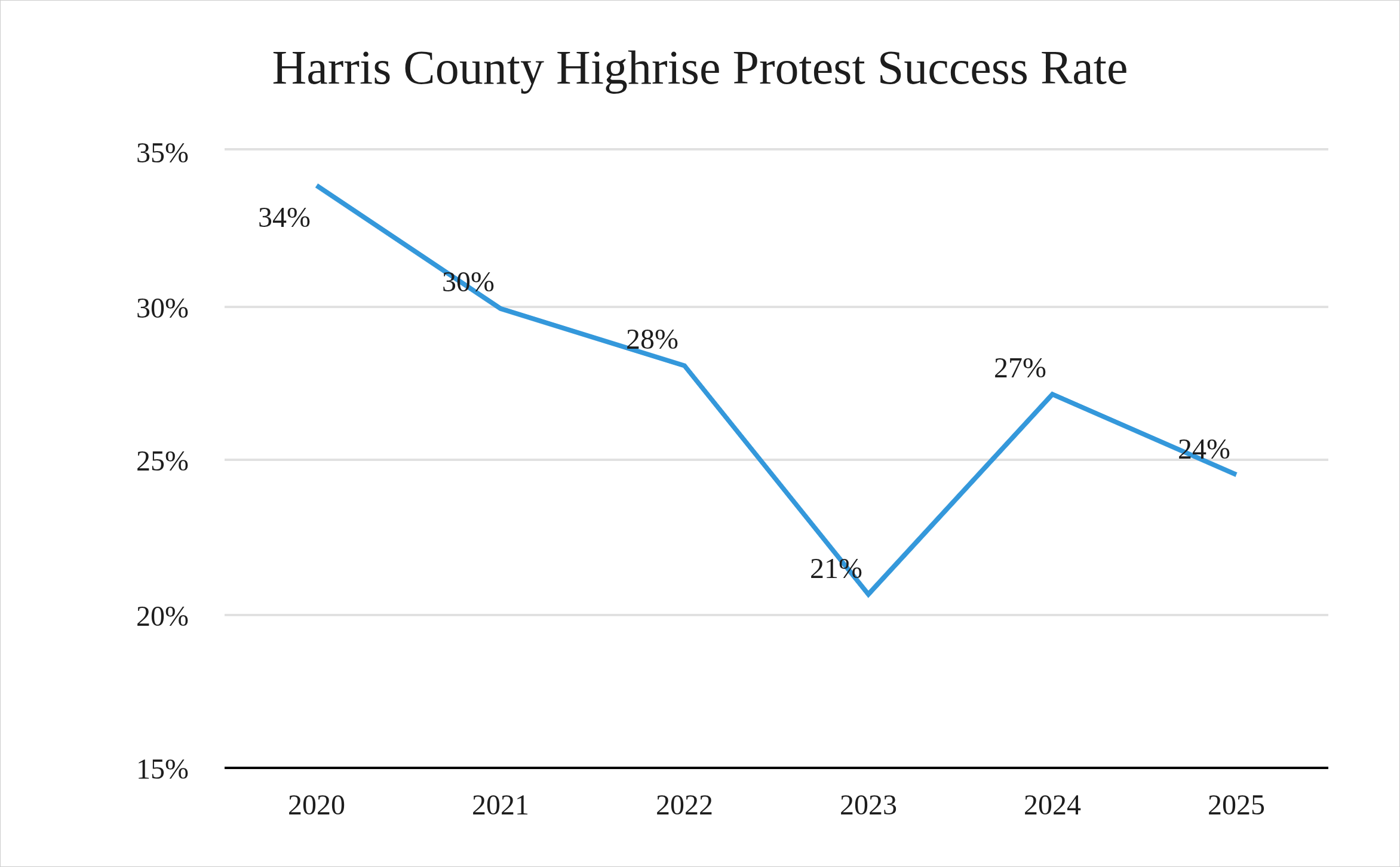
The easiest year to obtain a reduction was 2020, when roughly one-third of all protests resulted in a lower value. Success rates declined steadily through 2023 before recovering modestly in 2024 and 2025. While the protest process remains worthwhile, obtaining a reduction has become increasingly competitive.
Median Reductions Remain Significant
| Year | Median Reduction |
|---|---|
| 2020 | $26,778 |
| 2021 | $25,818 |
| 2022 | $23,090 |
| 2023 | $18,997 |
| 2024 | $20,414 |
| 2025 | $22,478 |
Even though success rates declined, successful protests continued to produce meaningful reductions. For many high-rise condominiums, a reduction of twenty thousand dollars or more in appraised value can translate into several hundred dollars in annual property tax savings.
High-Rise Condo Owners Are Increasingly Hiring Property Tax Agents
Perhaps the most striking trend is how dramatically homeowner behavior changed beginning in 2024.
| Year | DIY Protests | Agent Protests |
|---|---|---|
| 2020 | 2,390 | 1,716 |
| 2021 | 2,259 | 1,708 |
| 2022 | 2,846 | 1,328 |
| 2023 | 3,094 | 1,048 |
| 2024 | 1,612 | 2,762 |
| 2025 | 565 | 4,106 |
Between 2020 and 2023, most high-rise condo owners protested their own properties. By 2025, professional property tax agents represented nearly nine out of every ten protested units! The data does not explain why this shift occurred, but the change is too significant to ignore. Possible reasons include increased marketing by property tax firms, greater awareness of contingency-fee representation, or changing homeowner preferences.
DIY Homeowners Often Achieve Similar Reductions
Many homeowners assume professional representatives consistently negotiate larger reductions. The data tells a different story.
| Year | DIY Median Reduction | Agent Median Reduction |
|---|---|---|
| 2020 | $26,862 | $26,738 |
| 2021 | $24,554 | $26,968 |
| 2022 | $24,532 | $21,386 |
| 2023 | $19,486 | $18,178 |
| 2024 | $22,142 | $19,058 |
| 2025 | $23,736 | $21,207 |
When homeowners successfully protest, they generally obtain reductions comparable to those achieved by professional property tax firms. The primary advantage of hiring an agent appears to be increasing the likelihood of obtaining a reduction rather than negotiating substantially larger reductions.
Pro Tip: Review the Condition (C) and Desirability (D) Factors
When protesting a high-rise condo, condominium, or penthouse, don’t compare only square footage and floor plans.
HCAD assigns Condition (C) and Desirability (D) factors that can significantly affect your assessed value. Two otherwise identical condo units in the same building may have different appraised values because of differences in floor level, views, interior condition, renovations, or overall desirability.
If you own a penthouse or another top-floor condo, pay particular attention to these factors. Premium floors generally deserve higher values, but the premium should be supported by actual market evidence.
In some buildings, HCAD may assign dramatically higher C or D factors to the top floor compared to the floor immediately below. The important question is not whether the penthouse should be worth more, but whether buyers are actually paying that much more.
Compare the C and D factors assigned to similar units within your building. If the premium appears significantly larger than what recent sales support, it may become an important issue during your property tax protest.
Case Study: When a Penthouse Premium Exceeds the Market
One recent property illustrates why reviewing Condition (C) and Desirability (D) factors is so important. The property was a penthouse in a 30-story Houston high-rise condominium.
In 2025, the unit sold for ~$360,000. Although it was an estate sale, the property was listed on the MLS for nearly a month before going under contract. The marketing exposure and sale process indicated an open-market, arm’s-length transaction, making the sale a strong indicator of market value. For the 2026 appraisal, however, HCAD assigned the property a market value of approximately $580,000, more than 60% higher than its recent sale price!
The difference became even more apparent after comparing the penthouse with nearly identical units that sold in the same building, including units just one floor below. While penthouses generally deserve a premium because of better views, greater privacy, and the absence of upstairs neighbors, the market evidence did not support the magnitude of the premium reflected in HCAD’s appraisal.
This case demonstrates an important principle. A premium for the top floor is reasonable, but that premium should be supported by market evidence.
If your condo has recently sold, or if comparable units in your building have sold within the past year, compare those sales with HCAD’s appraised value. Also compare the Condition (C) and Desirability (D) factors assigned to your unit and neighboring floors. Those property-specific differences are often difficult for a mass appraisal model to capture accurately and can become compelling evidence during your property tax protest.
What Houston Condo and Penthouse Owners Can Learn
Several conclusions emerge from this analysis. First, protesting has become standard practice among Houston high-rise condo owners. More than forty percent challenge their valuations every year. Second, while professional property tax agents now dominate this market, homeowners who prepare strong evidence can still achieve reductions comparable to those obtained by professional representatives. Finally, successful protests continue to produce meaningful reductions. For many condo owners, reviewing recent sales within the same building and carefully evaluating HCAD’s Condition (C) and Desirability (D) adjustments can provide valuable evidence during the protest process.
For owners of luxury condominiums, high-rise condos, and penthouses, the best comparable properties are often found within the same building. Recent sales on neighboring floors frequently provide stronger evidence than comparable properties located elsewhere in Houston.
Methodology
This analysis uses Harris County appraisal and protest records for high-rise condominiums (Building Style Code 106, Use Code Z5) for tax years 2020 through 2025. The study includes 25,729 property tax protests filed across approximately 10,000 high-rise condominium units and examines protest participation, success rates, representation type, and median reductions over the six-year period.
Data source: HCAD public data
Future analyses will compare high-rise condominiums with other residential property types across Harris County.
Related Posts
Have questions? Use the comments section below to ask. We respond to all questions!