
Fort Bend County Property Tax Rates: Where Your Money Actually Goes
By Harsha N Hegde
Fort Bend County homeowners often wonder why their property tax bills feel so heavy. The truth is simple: Texas doesn’t have one property tax — it has layers of them. And Fort Bend has some of the highest levels of taxing-unit fragmentation in the state.
This article breaks down the median 2025 tax rates for every major taxing-unit type in Fort Bend County and shows how these rates impact a $400,000 home.
Data source:
https://www.fbcad.org/tax-rates/
If you’d like to estimate your own taxes using the county’s official tool, visit:
https://propertytaxestimator.fortbendcountytx.gov/
Why Fort Bend Property Taxes Are So High
Unlike states where property tax is a single line item, Texas allows multiple independent taxing units to levy taxes on the same home.
Your bill may include:
- County
- City
- School district
- MUD (Municipal Utility District)
- PID (Public Improvement District)
- Fresh water district
- Drainage district
- Emergency services district
- Community college district
- Special purpose districts
Each entity adds its own rate to your property value, and the stacked total is what you ultimately pay.
What Each Taxing Unit Costs You on a 400K Home
Using Fort Bend’s 2025 tax-rate data, the annual estimated burden looks like this:
- Public Improvement Districts (PID): ≈ $5,800
- School Districts: ≈ $4,348
- City (Municipal): ≈ $3,360
- Municipal Utility District (MUD): ≈ $2,820
- Fresh Water / Utility: ≈ $2,060
- County General: ≈ $1,648
- Special districts (Drainage, Emergency, College, etc.): $300–$1,000
- Foreign Trade Zones: $0
A Fort Bend homeowner can easily cross $8,000–$10,000 per year even before exemptions.
Median Tax Rates by Type
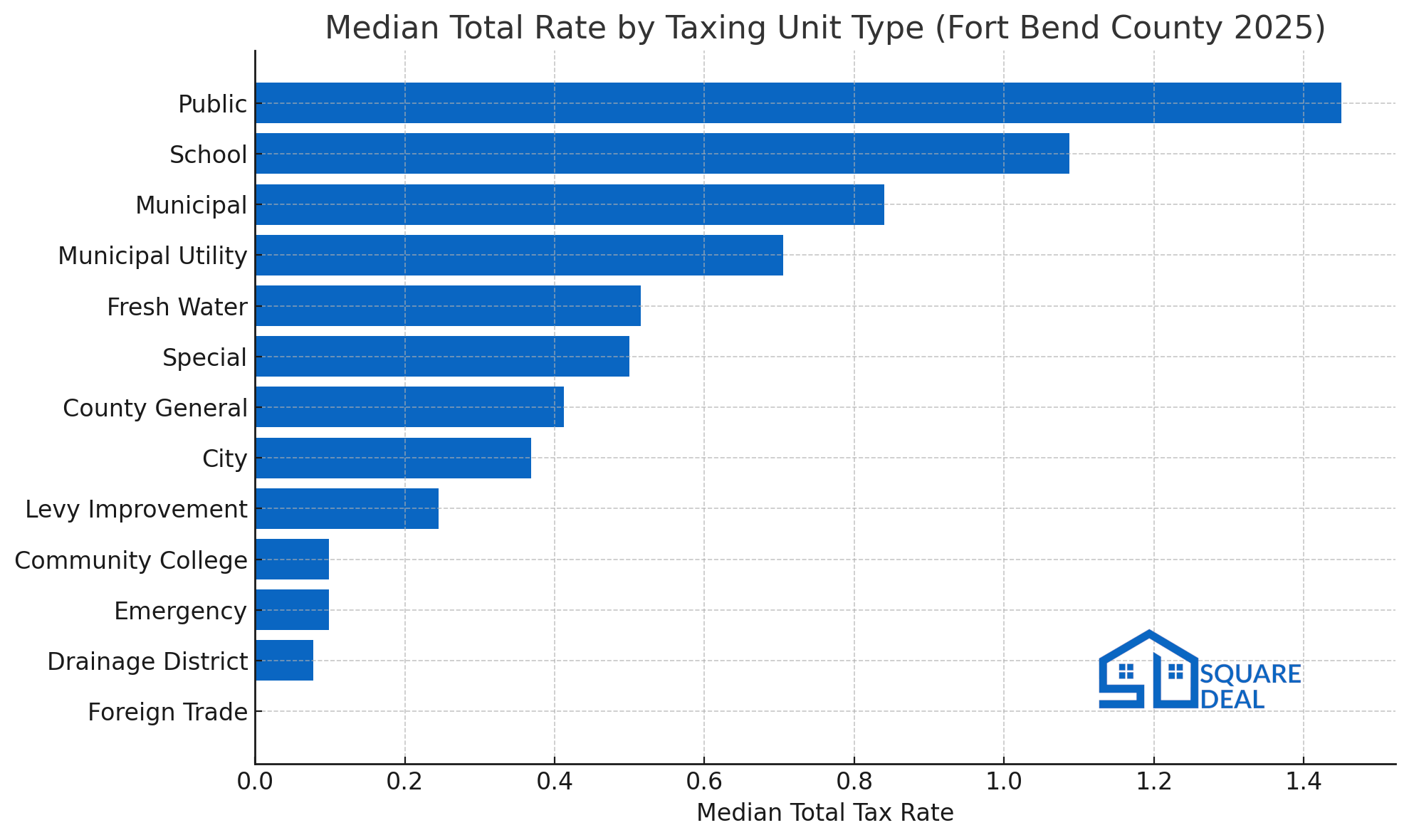
To understand how much each district type contributes, here is the median Total Rate for every taxing-unit type in Fort Bend County for 2025.
These values come directly from the Fort Bend Central Appraisal District tax-rate records.
| Taxing Unit Type | Median Total Rate |
|---|---|
| Public | 1.450000 |
| School | 1.087000 |
| Municipal | 0.840000 |
| Municipal Utility | 0.705020 |
| Fresh Water | 0.515000 |
| Special | 0.500000 |
| County General | 0.412000 |
| City | 0.368457 |
| Levy Improvement | 0.245000 |
| Community College | 0.098802 |
| Emergency | 0.098479 |
| Drainage District | 0.077500 |
| Foreign Trade | 0.000000 |
These medians make the pattern obvious:
- Public Improvement Districts and similar “Public” units levy the highest median rates.
- School districts remain the largest unavoidable tax for most homeowners.
- Cities and MUDs sit in the middle, but together create a meaningful portion of the bill.
- Smaller districts matter, but they don’t move the needle like schools or MUDs.
- Foreign Trade districts impose no burden on typical residential properties.
When these rates are applied to a $400,000 home, the stacked impact becomes immediately clear — and explains why Fort Bend tax bills feel so heavy.
Where Your Money Goes
Below is the visualization showing the median 2025 burden on a $400,000 home by taxing-unit type.
(Insert the chart created earlier — the “Where Your Money Goes” bar visual.)
This chart shows exactly how heavily each district contributes to the total tax bill.
What This Means for Homebuyers
Two homes priced at $400,000 can have very different tax bills depending on district boundaries.
Before buying a home in Fort Bend County, always check:
- Is the property inside a MUD?
- Is it within a PID?
- Are there multiple utility or special districts?
- What is the city rate vs. county-only rate?
Run your own estimate using the county tax estimator:
https://propertytaxestimator.fortbendcountytx.gov/
What This Means for Policymakers
These results highlight a structural issue:
Texas doesn’t just have high property taxes — it has highly fragmented property taxes.
A homeowner’s burden is determined less by the county and more by the number of layered districts under their neighborhood.
Simplification, consolidation, or transparency reforms could dramatically improve predictability and affordability.
Conclusion
Fort Bend County property taxes feel high because they result from a deeply layered system of taxing units. Understanding where each dollar goes empowers homeowners to make better buying decisions, prepare for annual increases, and protest effectively.
If you live in Texas, always look beyond the price of the home. The real cost lies in the districts beneath it.
Have questions? Use the comments section below to ask. We respond to all questions!