
DIY Property Tax Protest in Texas (2026 Step-by-Step Guide)
By Harsha N Hegde
Many Texas homeowners assume they need to hire a property tax agent to protest their appraisal. They do not. A homeowner can absolutely file and present a protest without an agent. The harder part is not the filing. The harder part is building a strong case with the right comparable properties and a clear argument. That is where many DIY protests succeed or fail.
This guide explains how to protest your property taxes yourself in Texas, what evidence matters most, and when it may make sense to get help.
What is a DIY property tax protest?
A DIY property tax protest means the homeowner handles the protest personally instead of hiring a property tax agent or attorney.
That usually includes:
- reviewing the Notice of Appraised Value
- gathering comparable properties
- filing the protest
- informal hearing (a.k.a Online Settlement Offer)
- going to the ARB hearing if needed
Texas homeowners are allowed to represent themselves. For many single-family homes, that is a realistic option.
While the process may look intimidating, it is not. With the right guidance and practice, you will be able to handle it yourself every year. Squaredeal makes DIY protests easy.
Is DIY better than hiring a property tax professional?
That is the wrong first question. A better question is this: “How much value actually gets reduced?”
Success rate matters, but it does not tell the full story. A case can count as a success even if the reduction is just a few hundred dollars! What matters is whether you got a meaningful reduction. That is why median reduction is the more useful metric.
Median reduction: where cases are actually won
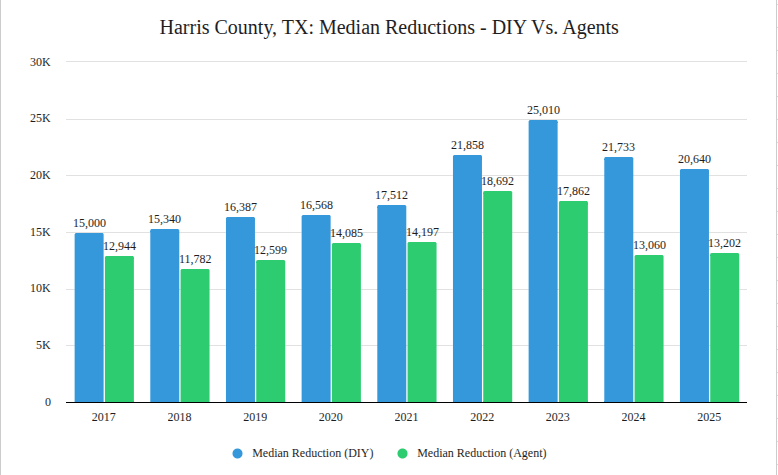
Success rate tells you whether you got a reduction. Median reduction tells you how much the system actually conceded. If you care about real outcomes, this is the metric that matters. Here’s how median reductions compare between DIY and agent-filed cases:
DIY cases consistently show higher median reductions across all years analyzed.
This pattern remains visible across years, even when market conditions and protest dynamics change.
| Year | Median Reduction (DIY) | Median Reduction (Agent) |
|---|---|---|
| 2017 | 15,000 | 12,944 |
| 2018 | 15,340 | 11,782 |
| 2019 | 16,387 | 12,599 |
| 2020 | 16,568 | 14,085 |
| 2021 | 17,512 | 14,197 |
| 2022 | 21,858 | 18,692 |
| 2023 | 25,010 | 17,862 |
| 2024 | 21,733 | 13,060 |
| 2025 | 20,640 | 13,202 |
Across every year in this dataset, DIY cases show higher median reductions than agent-filed cases. That does not mean DIY is always better. It does not mean agents are ineffective. What it likely means is simpler:
- DIY cases are often fewer and more focused
- Homeowners have just one property to focus on - theirs!
- Agents work at scale, which can lead to more standardized evidence and moderate outcomes.
- Big volume firms may tout high success rates. But when was the last time they talked about their median reduction?! 😊
The key takeaway is not “DIY beats agents.” The key takeaway is this - the system does not reward who filed the protest. It rewards how strong the case is. If your goal is just to get some reduction, success rate matters.
If your goal is to push for a larger reduction, precision matters more:
- tightly matched comps
- clear adjustments
- a focused argument
- a value conclusion that is reasonable and well-supported
Historically, DIY homeowners have had a higher success rate than property tax professionals or protest firms!
Cost of DIY vs hiring a property tax professional
Cost is one of the biggest differences between DIY and hiring a property tax professional or firm.
DIY cost
For most homeowners:
- Filing a protest: free
- Gathering comps: your time
- Tools or reports: optional
Typical out-of-pocket cost:
- $0 if you do everything manually
- ~$50 to $100 if you use a comps report or tool
Agent cost
Most property tax agents work on a contingency model.
Typical structure:
- 30% to 50% of the tax savings
- Some may charge minimum fees or admin fees
Example:
- Tax savings: $1,000
- Agent fee (40%): $400
- Your net savings: $600
What this means in practice
DIY:
- low cost
- more effort
- higher dependence on your ability to build a strong case
Agent:
- higher cost
- less effort
- more convenience
The trade-off most homeowners miss
Cost is not just about money. It is about how much value you retain.
If two approaches produce similar reductions:
- DIY keeps nearly all of the savings
- agent fees reduce your net benefit
If one approach produces a stronger reduction:
- that difference can outweigh the fee
The right way to think about it
Do not ask:
“Which option is cheaper?”
Ask:
“Which option gives me the best net outcome after fees, given the strength of my case?”
Because in property tax protests:
- weak evidence produces small reductions
- strong evidence produces larger reductions
- fees determine how much of that you actually keep
How to protest property taxes in Texas yourself
For most homeowners, the process looks like this.
1. Review your Notice of Appraised Value
Start with the basic numbers and facts.
Check:
- appraised value
- market value
- property characteristics
- square footage
- year built
- any obvious errors
If the appraisal district has incorrect facts about your home, fix that first.
2. Gather strong comparable properties
This is the core of the case. The best comps are not random nearby homes. They should be genuinely comparable in ways that matter:
- same neighborhood or market area
- similar size
- similar age
- similar quality and condition
- similar lot characteristics
- similar features
Good protests are built on a small number of strong comps, not a large pile of weak ones. For most homeowners, three to five strong comps are more useful than twenty bad ones.
3. File your protest on time
In Texas, the usual property tax protest deadline is May 15 or 30 days after the notice was delivered, whichever is later. You can usually file:
- online through the appraisal district portal
- by mail
- in some counties, by email or other local process
Do not miss the MAY 15th deadine!.
4. Settlement Offer (or Informal Hearing)
Most residential protests are resolved here. If you filed your protest online and submitted your evidence, you will likely get a settlement offer from the appraisal district. Refer to our guide on when to accept the offer. If you filed a paper protest, then you may need to meet the CAD appraiser, who will review your evidence and present you a counter offer. Most DIY protests conclude here, with a decent reduction.
5. Go to the ARB if needed
If the informal offer is not reasonable, you can continue to the Appraisal Review Board hearing. This is more formal than the informal stage, but homeowners can still handle it. You may find our detailed guide on ARBs may helpful. At the ARB, facts and relevant comps matter far more than emotion. Keep it factual and focused. A strong presentation usually includes:
- your current appraised value
- your proposed value
- a short set of strong comps
- a brief explanation of why those comps support your number
Last, but not the least - ensure your homestead exemption is in place!
What is the best evidence to protest property taxes?
The best evidence is usually photos of damaged portions of your property along with repair estimates. Think: “If I were to put this house on the market, what would bring down its value?”. e.g., foundation cracks, mold damage, worn out kitchen, leaking roof etc. Routine maintenance items may not count.
But not all properties need repairs all the time! In such cases, an equally strong evidence are comparable properties. In Texas, there are two main types:
1. Equity comps
These are similar properties that the appraisal district has assessed lower than yours. Equity comps are often powerful because Texas law requires equal and uniform appraisal. If similar homes are assessed lower, that can strengthen your case.
2. Sales comps
These are recent sales of similar properties that support a lower market value. Sales comps can be useful, but they need to be truly comparable. A sale from a very different neighborhood, size range, or condition profile will not help much.
Squaredeal automatically picks the best set of equity and/or sales comps for you!
What usually does not work well
- Zillow screenshots
- broad market averages
- emotional arguments
- irrelevant nearby homes
- comps that are clearly inferior to the subject
Specific, property-level evidence works. Generic evidence usually does not.
Is it worth it to protest property taxes?
In many cases, yes. A common myth is this: “My value did not go up, so there is no point protesting”. That is wrong. A value can stay flat and still be too high relative to comparable properties. A home can also be appraised unevenly compared with similar homes nearby. If your property is overstated, a protest may still be worth it even in a flat or declining year.
There are no downsides to protesting! - You either get a reduction or not. But ARB can’t raise your value!.
What should you write in a property tax protest?
Keep it short. Keep it factual. A solid protest argument usually says:
- what value the district assigned
- what value you believe is more reasonable
- what comps support your conclusion
You do not need dramatic language. You need relevant facts. A concise, evidence-backed argument is far stronger than a long narrative.
Common DIY mistakes
Many weak DIY protests fail for predictable reasons.
- Using poor comps - This is the biggest problem. Nearby does not automatically mean comparable.
- Using too many comps - More is not better. Weak comps dilute the case.
- Ignoring adjustments - If your comp is larger, newer, renovated, or otherwise superior, that difference needs to be addressed.
- Making emotional arguments - The appraisal district is not deciding whether your taxes feel unfair. It is deciding value and uniformity.
- Missing the deadline - A great case filed late is still late.
When DIY makes sense
DIY can make sense when:
- the property is a typical single-family home
- you can spend a little time to prepare
- you can get solid comps
- you are willing to present the case yourself
For many Texas homeowners, that is enough.
When hiring help may make more sense
Getting help may make sense when:
- the property is commercial, multifamily, or otherwise complex
- the home is highly unique with few good comps
- you do not have time to prepare
- you are not comfortable handling the hearing process
There is nothing wrong with hiring help. The mistake is assuming that hiring help automatically means a stronger case. It may or may not.
In case you decide to hire a professional, choose an agent / firm operating locally in your area. They will have a better understanding of your neigbhborhood and your county’s protest process.
Most high volume protest firms may tout a “high success rate”, but in reality, their median reductions are low! That’s one metric they shy away from advertising!
Reason is anyone’s guess - when a protest firm or agent is chasing volume, quality and depth of evidence is not their focus. These high volume protest firms mostly resolve their protests via “Topline Settlements a.k.a. Agreed Orders”. Everybody gets “some reduction”. Not necessarily the best reduction they could have got!
The real lesson from the DIY vs agent data
The strongest conclusion from the Harris County median reduction data is not that one side always wins. It is that focused, property-specific evidence matters. Homeowners who protest on their own often give one property concentrated attention. That can lead to stronger comp selection and a tighter argument. Agents often operate under scale constraints. That can bring consistency, but it can also lead to more standardized cases. That is why homeowners should stop asking only:
“Should I DIY or hire an agent?”
They should also ask:
- How will the comps be selected?
- How customized will the case be?
- How strong is the value support?
- Is this evidence actually specific to my property?
Those questions matter more than the label on who filed the protest.
Final thoughts
DIY property tax protest in Texas is absolutely possible. For many homeowners, it can work well. But filing the protest is the easy part. The real work is building a case with strong, relevant, property-specific evidence. That is where outcomes are shaped. Strong evidence wins.
Frequently asked questions
How do I protest my property taxes myself in Texas?
Review your notice, gather strong comparable properties, file before the deadline, present your case at the informal hearing, and go to the ARB if needed.
What is the best evidence for a property tax protest?
The best evidence is usually strong comparable properties. In Texas, equity comps and relevant sales comps are often the most useful.
Is it worth protesting property taxes if my value did not go up?
Yes. A flat value can still be too high relative to comparable properties or uneven compared with similar homes.
Is DIY property tax protest better than hiring an agent?
Not automatically. The stronger conclusion is that better evidence tends to produce better outcomes, regardless of who files.
How many comps should I use in a DIY protest?
For most residential protests, three to five strong comps are usually better than a long list of weak ones.
About the Author
Harsha N Hegde is the founder of squaredeal.tax, a DIY platform that helps Texas homeowners protest unfair property tax assessments. He has helped thousands of Texas homeowners save money using comps-based evidence and practical guidance.
Related Posts
Have questions? Use the comments section below to ask. We respond to all questions!